Shopping Cart
Your shopping cart is empty!

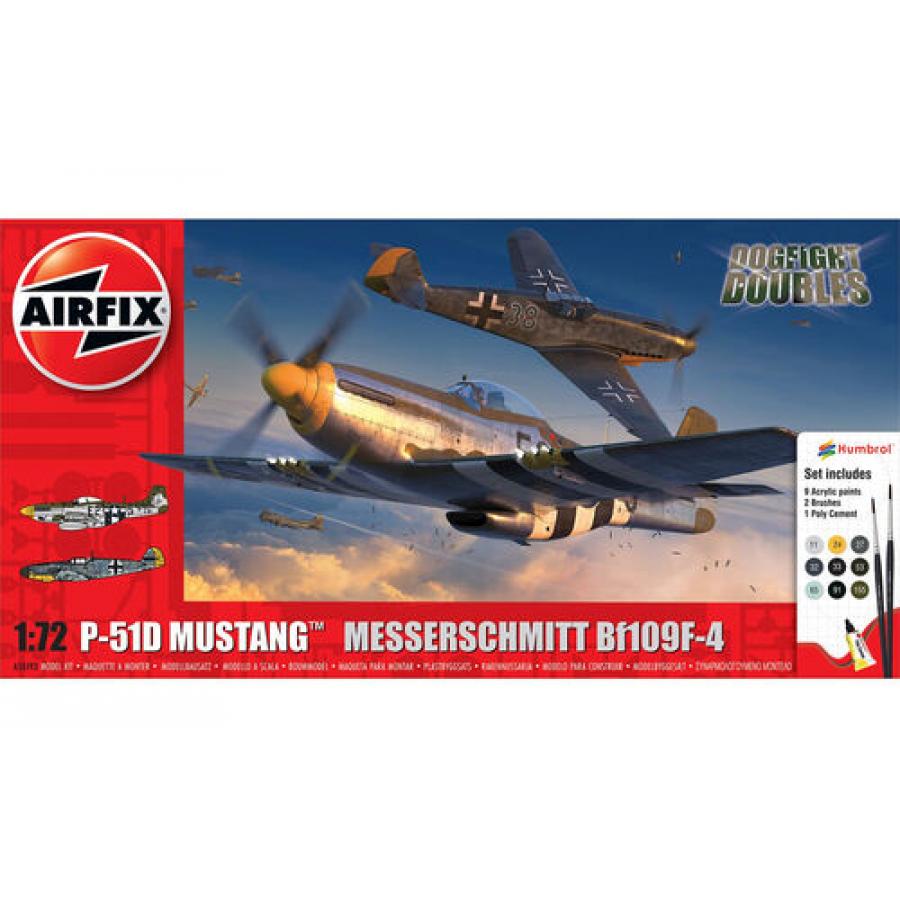
The North American P‑51 Mustang is an American single‑engine, long‑range fighter and attack aircraft featuring a classic tail configuration and an all‑metal construction. The prototype first flew on 26 October 1940. The P‑51 Mustang earned a reputation as one of the best—if not the best—fighters of the Second World War.
Replacing the original Allison V‑1710‑39 engine with the Rolls‑Royce Merlin (P‑51 Mustang Mk.Ia version) transformed the aircraft and allowed it to reach unprecedented levels of performance. The single‑seat fighter impressed with its maximum speed, range, maneuverability, and powerful armament.
The combination of all important performance parameters made the Mustang excel in virtually every role assigned to it: it achieved air superiority, escorted bombers, performed reconnaissance missions, and executed ground‑attack operations. Its outstanding design is further demonstrated by the fact that the Mustang remained in active service until the 1970s.
One of the most significant versions was the P‑51D, based on the P‑51B. It received a bubble canopy, providing excellent visibility, and a new Packard V‑1650‑7 engine, which significantly improved performance.
Technical data (P‑51D):
Length: 9.83 m
Wingspan: 11.28 m
Height: 4.08 m
Maximum speed: 703 km/h
Rate of climb: 16.3 m/s
Maximum range: 2,755 km
Service ceiling: 12,800 m
Armament:
Fixed: 6 × 12.7 mm M2 machine guns
External: up to 908 kg of bombs or 10 × 127 mm HVAR rockets
The Messerschmitt Bf‑109 is a German single‑engine, all‑metal fighter aircraft with a low‑wing configuration and a classic tail. It became the primary and most widely produced fighter of the Luftwaffe during World War II. The prototype first flew on 29 May 1935, and serial production continued from 1936 to 1945. In total, approximately 35,000 Bf‑109s of all variants were produced—many of which later served in the Czechoslovak and Israeli air forces.
The origins of the Bf‑109 go back to a 1933 Luftwaffe competition for a new fighter aircraft. Initially losing to the He‑112, the Bf‑109 project ultimately prevailed thanks in part to the political maneuvering of Willy Messerschmitt, eventually becoming the Luftwaffe’s main fighter.
Several major variants were developed during production:
Bf‑109B (Berta): pre‑production series powered by various versions of the Junkers Jumo 210 engine; tested in the Spanish Civil War (from 1937).
Bf‑109C (Caesar): featured a different engine and heavier armament (two 20 mm cannons + two 7.92 mm MGs). Also used in Spain.
Bf‑109D (Dora): powered by the Junkers Jumo 210 Da or Daimler‑Benz DB 600. Used in the September Campaign (1939), but replaced by the E‑series by late 1939/40.
Bf‑109E (Emil): the most famous early variant, powered by the Daimler‑Benz 601A/N. First to use a three‑blade propeller. Fought in the French campaign, Battle of Britain, North Africa, and on the Eastern Front. Ace Adolf Galland first flew in this variant.
Bf‑109F (Friedrich): considered by German pilots to be the most aerodynamically refined version. Featured redesigned wings, fuselage, and canopy fairing; entered service in 1940/41.
Bf‑109G (Gustav): the most widely produced variant, powered by the new Daimler‑Benz DB605A engine (1,475 HP). Armament typically included two 13 mm MG131 machine guns in the fuselage and one MG151 20 mm or MK108 30 mm cannon firing through the propeller hub.
Bf‑109K (Kurfürst): the last mass‑production variant, introduced in October 1944. Powered by the DB605DB or DC engine, it was the fastest Bf‑109 of WWII, reaching up to 730 km/h.
Two additional variants (H and Z) were created for experimental purposes but never entered mass production.
Continuous improvements in propulsion and armament made the Bf‑109 one of the most dangerous fighters of World War II, while also demonstrating the enormous potential of Willy Messerschmitt’s angular yet highly effective airframe design.
Technical data (Bf‑109 G‑6):
Length: 8.95 m
Wingspan: 9.92 m
Height: 2.6 m
Maximum speed: 640 km/h
Rate of climb: 17 m/s
Maximum range: 850 km
Service ceiling: 12,000 m
Armament:
Fixed: 2 × 13 mm MG131 machine guns + 1 × 20 mm MG151 cannon
External: 250 kg bomb or 2 × Wfr. Gr. 21 rocket launchers