Shopping Cart
Your shopping cart is empty!

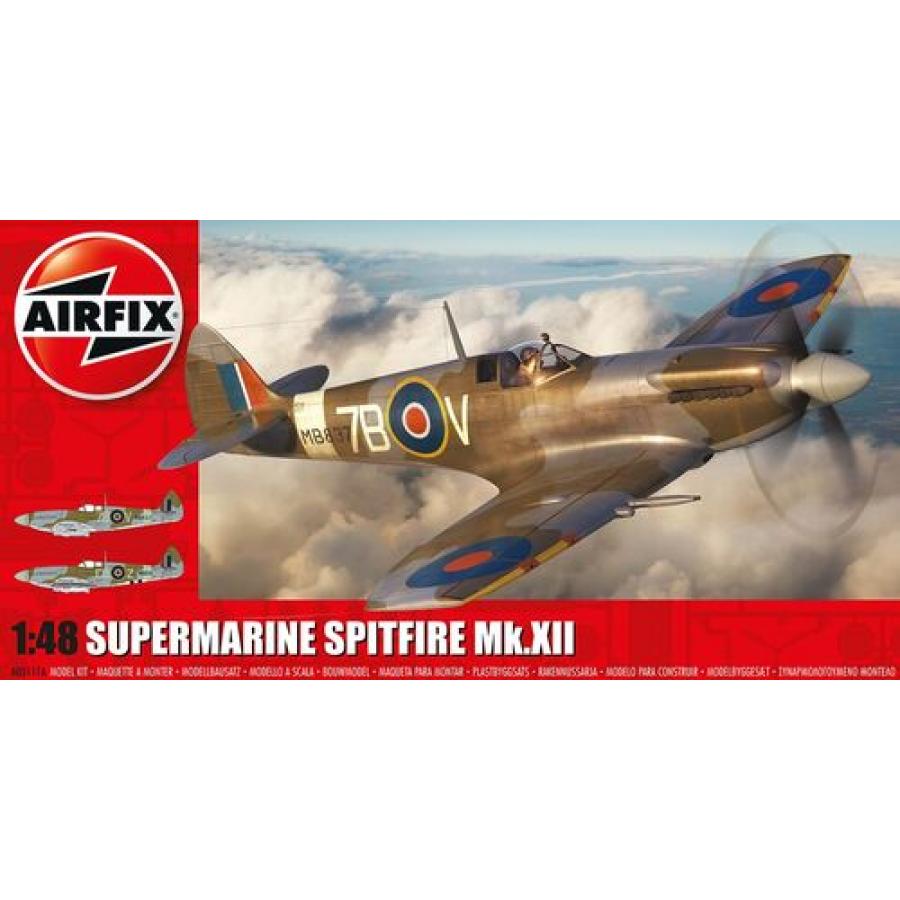
The Supermarine Spitfire is perhaps the most famous British fighter aircraft of the Second World War. It was an all‑metal machine with a low‑wing configuration, characteristic elliptical wings, a conventional tail unit, and retractable landing gear. The prototype’s first flight took place on 5 March 1936.
The Spitfire proved to be the backbone of the RAF during the war, and it continued to perform well after the war, remaining in production for ten years. Its story began in the design office of R.J. Mitchell, the chief designer at Supermarine. The first aircraft were delivered to RAF units in 1938, and by the time the Battle of Britain began in the summer of 1940, there were already 19 squadrons of modern fighters stationed at airfields—alongside the slightly older Hurricanes, they defended the British Isles with a combined total of 600 aircraft.
As the war expanded, the Spitfire served wherever the RAF operated: in the Far East, North Africa, Italy, during the Normandy landings, the battles in France, and finally in the operations over Germany in 1945. For many Britons, it became a symbol of victory in World War II.
This remarkable aircraft had at least a dozen production variants. Among the most important was the first mass‑produced version, the Spitfire Mk.I, powered by a Rolls‑Royce Merlin II engine with 1,030 horsepower. This was the aircraft that contributed so decisively to the Battle of Britain. Many variants of this model were developed, including the PR Mk IA (reconnaissance version) and PR.IG (armed reconnaissance).
Another significant version was the Spitfire Mk.V, powered by the Rolls‑Royce Merlin 45 engine with 1,440 HP. Later aircraft used the Merlin 50 engine. Serial production of this variant began in 1941 as the RAF’s answer to the appearance of the Messerschmitt Bf‑109F.
A very successful later version was the Spitfire Mk.IX, powered by the Merlin 61 engine and equipped with a four‑bladed propeller. It was developed to counter the Focke‑Wulf Fw‑190 and entered production at the end of 1941. This version underwent many modifications; for example, in 1944 it received a new gyro gunsight, an enlarged rudder, and a different wing system.
Another important version was the Spitfire Mk.XIV, powered by the Rolls‑Royce Griffon 61 engine and fitted with a five‑bladed propeller. Serial production began in October 1943.
One of the last production series was the Mk.21. This version used the Griffon 61 engine, had a heavily reinforced structure and airframe, and featured extended wings that increased the total wing area. Mass production began in March 1945.
Length: 9.14 m
Wingspan: 11.23 m
Height: 3.05 m
Maximum speed: 717 km/h
Rate of climb: 18.5 m/s
Service ceiling: 13,200 m
Maximum range: 1,815 km
Armament:
Fixed: 4 × 7.7 mm machine guns and 2 × 20 mm Hispano Mk II cannons
External: up to 225 kg of bombs