Shopping Cart
Your shopping cart is empty!

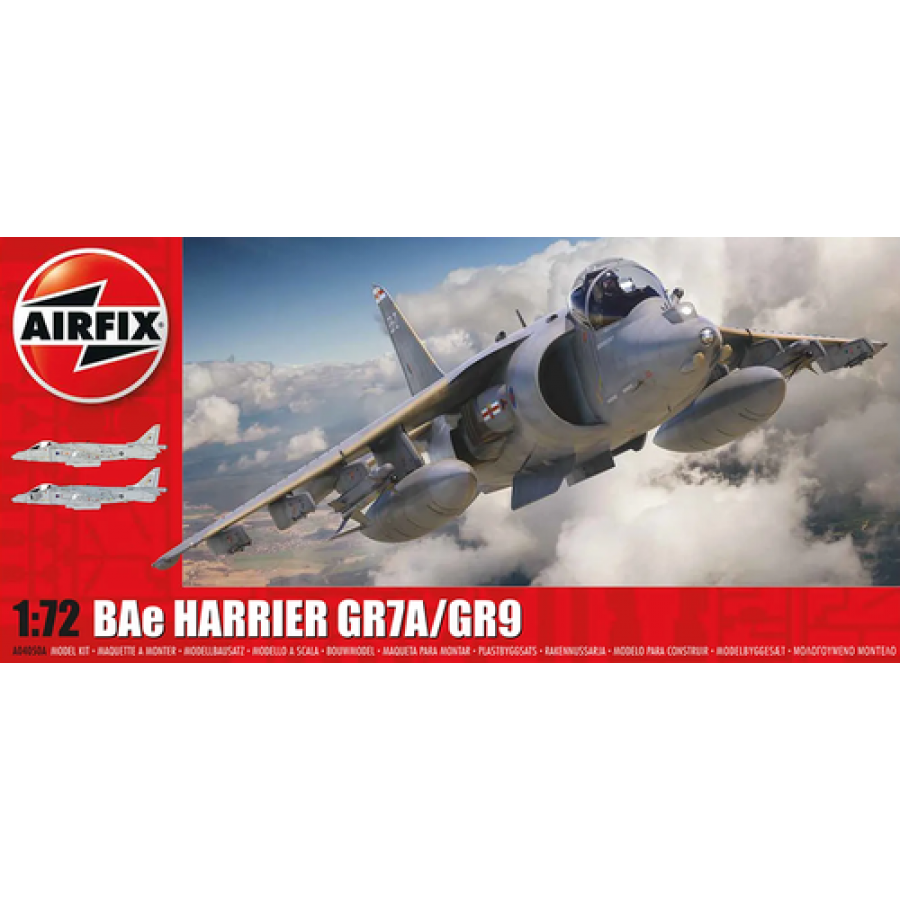
The BAe Harrier is a British single-seat fighter, attack, and reconnaissance aircraft with V/STOL capability, featuring a duralumin semi-monocoque structure. The origins of the Harrier date back to 1957, when Lord Sydney Camm of Hawker Aircraft and Dr. Stanley Hooker of Bristol Siddeley Engines began developing a tactical aircraft using the latest turbo-fan engine from Bristol, then known as the BS.53. The engine was specifically adapted for vectored thrust, enabling vertical takeoff of a fixed-wing aircraft. Exhaust gases were directed through four rotating nozzles, arranged in pairs at the front and rear of the fuselage. The nozzle rotation range exceeded 90 degrees, allowing exhaust to be directed backward in normal flight, vertically downward for takeoff and landing, or at any angle during transition.
Around the engine, Camm designed a compact, conventional metal frame with high-mounted wings. The single-seat cockpit was at the front of the fuselage, alongside two fixed semicircular air intakes for the engine. The main landing gear consisted of twin wheels and a single nose wheel, aligned along the fuselage centerline.
The first of six prototypes took its maiden flight on 21 October 1960. Less than a year later, the aircraft successfully transitioned between vertical climb, horizontal flight, and hover. In February 1965, the UK government ordered six trial aircraft, the first to carry the name Harrier. Besides the UK, the only other operator of the standard Harrier is the Spanish Navy, where the aircraft is known as the Matador.
To date, approximately twelve versions of the Harrier have been produced. Chronologically, the first was the Harrier GR.1, an attack aircraft entering service in 1969. The T.3 version followed—a two-seat trainer based on the GR.1. The Harrier GR.3 became the most advanced attack version, powered by Pegasus 11 Mk 103 engines. From 1978, the Sea Harrier FRS.Mk.1 entered service, gaining fame as a fighter-attack aircraft during the 1982 Falklands War. Lessons from this conflict led to the development of the FA.2, featuring improved electronics, including the Blue Vixen radar, higher payload capacity, and compatibility with a wider range of weapons.
Technical data (GR.3 version):
Length: 14.37 m
Wingspan: 7.6 m
Height: 3.42 m
Maximum speed: 1185 km/h
Maximum climb rate: 254 m/s
Combat radius: 420 km
Armament: fixed – none; underwing – up to 3176 kg of payload.