Shopping Cart
Your shopping cart is empty!

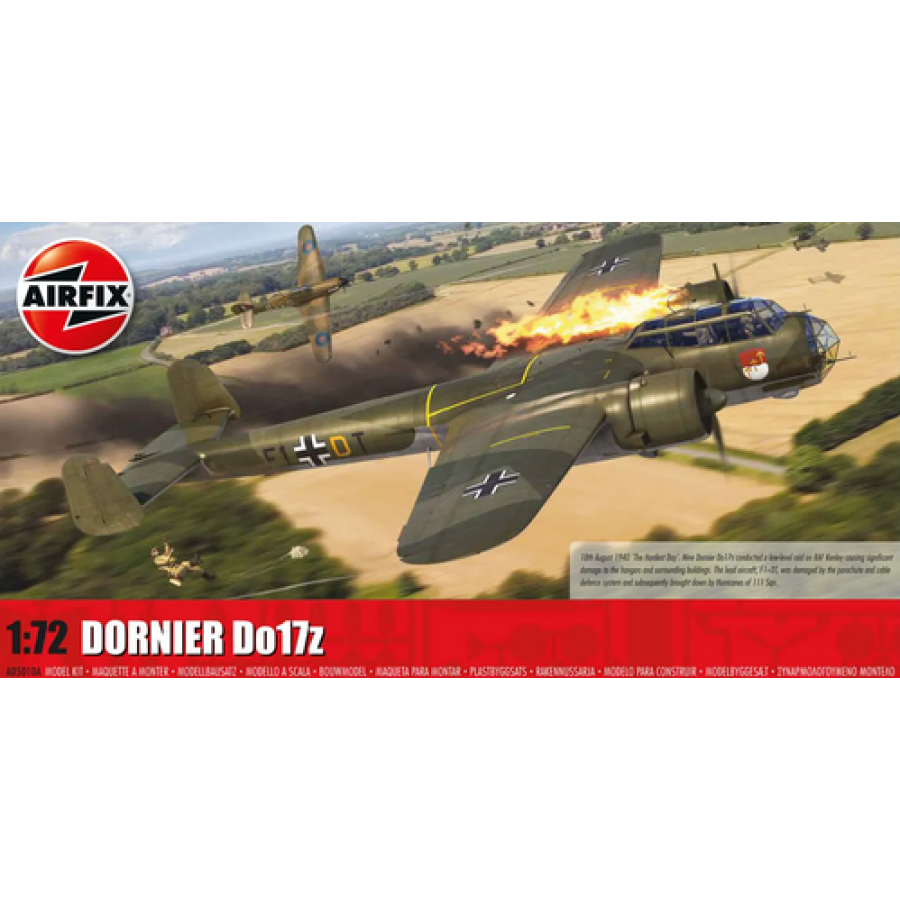
The first prototype Do-17C flew on 23 November 1934. Shortly afterward, the prototype was designated as the Do-17 V1. In May and September 1935, the first flights of the next two prototypes, Do-17 V2/V3, took place. From the beginning, the Luftfahrtkommissariat showed great interest in the new design.
The first Do-17 V1 prototype was built solely for military purposes, while the next two were used as civilian aircraft. The military version of the aircraft had two fuselage bomb bays located on the right side of the central section, capable of carrying five 50 kg bombs mounted vertically. The crew of the Do-17 V1 consisted of three members: the pilot, seated on the left side of the cockpit; the navigator-bombardier; and the gunner-radio operator, seated behind him. There were four small windows on each side of the fuselage, providing the gunner with better visibility.
By early 1936, mass production of the Do-17E-1 and Do-17F-1 versions was being prepared, and both were soon produced. The Do-17F-1 aircraft lacked bomb sights and bomb racks but were equipped with an additional fuel tank and three fixed-range cameras. In 1937, the Do-17E-2 and E-3 versions were created, followed by the Do-17F-2, which differed slightly from its predecessors in equipment.
In total, 536 Do-17 E and F aircraft were built, including 268 at the main factory and the rest under license in other plants. From early 1937, these aircraft began service with Luftwaffe units. The most widely produced version was the Do-17Z, with 872 units built.
The Do-17 performed well during the Spanish Civil War and the September Campaign. It also participated in the battles against France and in the Battle of Britain in 1940. It suffered relatively high losses there, leading to its replacement in frontline units by Ju-88 and He-111 bombers after 1940. Retired Do-17s were mainly used as glider tugs.
Technical data (Do-17Z version):
Maximum speed: 410 km/h
Service ceiling: 8200 m
Operational range: 1010 km
Armament:
Fixed: 6 × MG15 machine guns, 7.92 mm
Mounted: up to 1000 kg of bombs